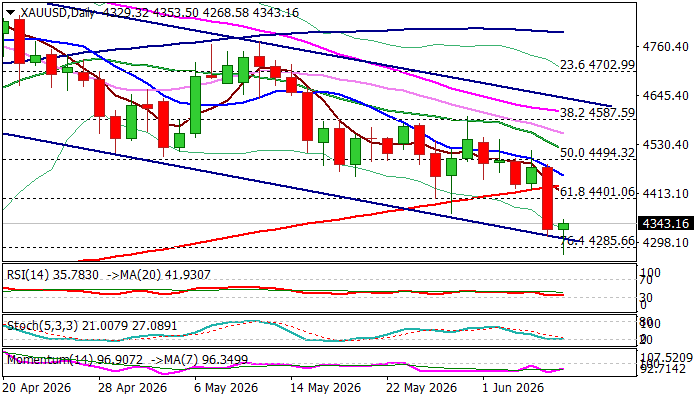
Gold may enter a consolidation phase above channel support ahead of another downside attempt
Gold remains under heavy pressure on Monday, extending Friday’s sharp 3.2% decline—the steepest daily drop since March 19—and falling to its lowest level in two and a half months.
The precious metal continues to be weighed down by stronger-than-expected U.S. May employment data, which reinforced expectations of a more hawkish Federal Reserve policy path. At the same time, renewed escalation in the Middle East has heightened inflation concerns, further supporting the U.S. dollar and adding pressure on gold prices.
The technical outlook remains decisively bearish. Friday’s break below the 200-day moving average, which had successfully contained several previous downside attempts, as well as the violation of the 61.8% Fibonacci retracement of the $4,099–$4,889 rally at $4,401, generated a strong bearish signal and paved the way for today’s test of bear-channel support near $4,305. Initial selling pressure has eased around this level as bears encounter stronger support.
Near-term price action may stabilize temporarily given the significance of channel support and the potential for profit-taking following last week’s steep losses. However, any recovery attempts are likely to remain limited and may offer fresh selling opportunities, as the broader technical structure remains negative. Moreover, rising expectations for a Federal Reserve rate hike following the robust nonfarm payrolls report continue to underpin the dollar and weigh on the non-yielding metal.
On the upside, the broken 200-day moving average at $4,432 now acts as strong resistance. Additional bearish pressure could emerge as the declining 10-day moving average approaches the 200-day average, with a potential bearish crossover (death cross) in sight.
A decisive break below channel support at $4,305 would reinforce the bearish outlook and expose the key support level at $4,099, the 2026 low recorded on March 23.
Conversely, only a sustained recovery above the $4,500 region—former major support that has now turned into resistance—would significantly weaken the current bearish bias.
Res: 4366; 4401; 4432; 4500
Sup: 4305; 4285; 4200; 4099