
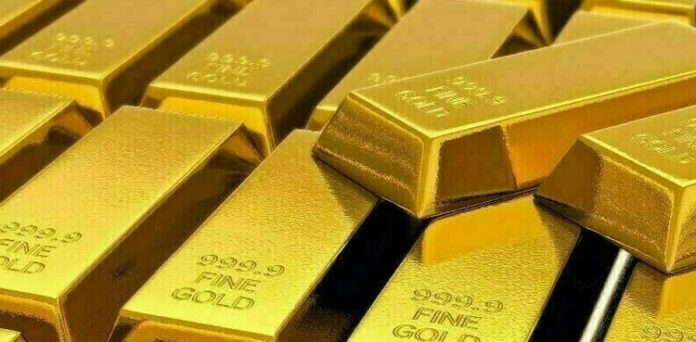
Gold Falls Below $3,800 as Rising Fed Rate Expectations Fuel Selling Pressure
Gold prices extended their losses on Wednesday, falling below the $3,800-per-ounce mark and moving closer to fresh 14-month lows as expectations of additional Federal Reserve rate hikes continued to weigh on investor sentiment. Persistent inflation concerns and a stronger U.S. dollar reinforced the bearish outlook for precious metals.
Spot gold declined 1.5% to $3,790.18 per ounce, while U.S. gold futures fell 1.1% to $3,823.67. Losses were also seen across the broader precious metals complex, with silver easing 0.8% to $47.0145 per ounce, platinum slipping 0.5% to $1,424.45, and palladium falling 0.7% to $965.10. Palladium futures were down 0.9% at $963.00, while the U.S. Dollar Index advanced 0.1% to 103.65.
The latest decline follows a weak close in the previous session, when bullion settled at its lowest level since September 2025. Hawkish remarks from Federal Reserve officials added to the pressure, with Alberto Musalem, President of the St. Louis Federal Reserve, suggesting that several additional rate increases may be required before spring. Meanwhile, John Williams, President of the Federal Reserve Bank of New York, reiterated that policymakers still have further work to do before inflation returns to the Fed’s target.
Gold has now surrendered more than a quarter of its value since the outbreak of the U.S.-Iran conflict earlier this year. Rising energy prices linked to the conflict contributed to stronger inflationary pressures, prompting central banks to maintain a tighter monetary policy stance. Markets are currently pricing in additional quarter-point rate increases over the coming months.
Further weighing on bullion, benchmark U.S. Treasury yields remain elevated, with the 10-year yield approaching its longest period above 5% in nearly twenty years. Higher yields tend to reduce the attractiveness of non-interest-bearing assets such as gold by increasing the opportunity cost of holding them.
Investors are now turning their attention to the upcoming minutes from the Federal Reserve’s October policy meeting, which may provide greater clarity on the central bank’s outlook for interest rates and inflation. Earlier this week, Kevin Warsh, Chair of the Federal Reserve, refrained from offering direct guidance on monetary policy, focusing instead on the potential economic implications of artificial intelligence.
According to analysts at ANZ, the recent selloff may attract opportunistic buying interest in the near term. However, continued monetary tightening and a potential recovery in equity markets following the technology-led correction could divert investment flows away from precious metals.
The bank’s baseline scenario remains additional quarter-point rate increases over the coming meetings, although it has not ruled out the possibility of a larger move if inflation remains persistent. With markets already pricing in substantial additional tightening, ANZ noted that further increases in borrowing costs could prolong gold’s near-term correction.
Despite the current weakness, ANZ maintains a constructive medium- to long-term outlook for gold. The bank argues that growing uncertainty surrounding government funding, debt negotiations, and the broader fiscal outlook could enhance gold’s role as a portfolio diversifier. In its longer-term projections, ANZ expects renewed strategic and retail demand to establish support near $3,600 per ounce, with the potential for prices to reach $4,800 by 2027.
