Crude Oil Prices Rally Sharply Amid Escalating US–Iran Tensions
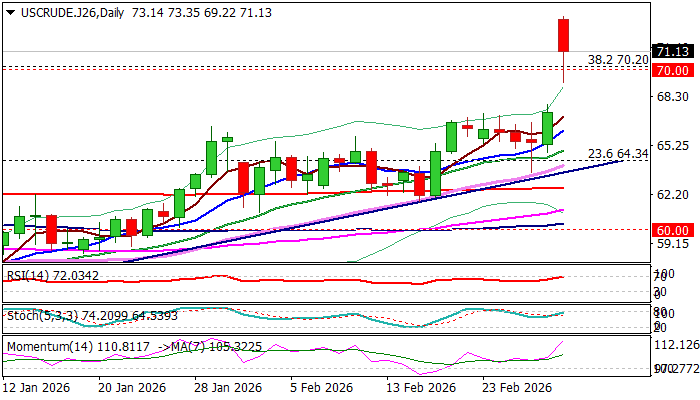
WTI oil opened Monday with a sharp $6 upside gap after hostilities between Israel, the United States, and Iran erupted over the weekend.
The front-month contract surged to $73.35 per barrel, up from Friday’s close at $67.30, marking its highest level since June 23. While markets had partially priced in the risk of escalation, the initial reaction was relatively measured given the gravity of the situation and the speed with which the conflict intensified and spread across the Middle East.
Compared with the 1974 Middle East oil embargo, today’s response appears more restrained, suggesting additional upside potential. In that historical context, the $100 per barrel region is often viewed as a rough equivalent benchmark under current market conditions.
Traders are closely monitoring the risk of prolonged supply disruptions, particularly around the Strait of Hormuz, through which roughly one-fifth of global oil supply transits. Recent developments indicate the conflict may extend beyond initial expectations, with US President Donald Trump signaling that hostilities could last several more weeks rather than just a few days.
A sustained disruption would pose significant risks to the global economy, potentially triggering a renewed surge in oil prices, reigniting inflationary pressures, and driving broader cost increases worldwide.
In the near term, price action is consolidating below the new multi-month high while holding firmly above the key psychological $70 level, which aligns closely with the broken 38.2% Fibonacci retracement of the $95.00/$54.87 decline, keeping the short-term bias tilted in favor of bulls.
Below $70, immediate supports are seen at $69.22 (today’s low), followed by $68.41 (100-day moving average) and $67.81 (Friday’s peak).
On the upside, $73.35 marks initial resistance, ahead of $74.94 (50% retracement) and $75.60 (200-day moving average).
Res: 73.35; 74.94; 75.60; 77.62
Sup: 70.20; 70.00; 69.22; 68.41